Internal Audit Software vs Compliance Automation: What Each Category Actually Closes
Internal audit software vs compliance automation: learn which one closes your assurance work, which one produces audit evidence, and how to choose.
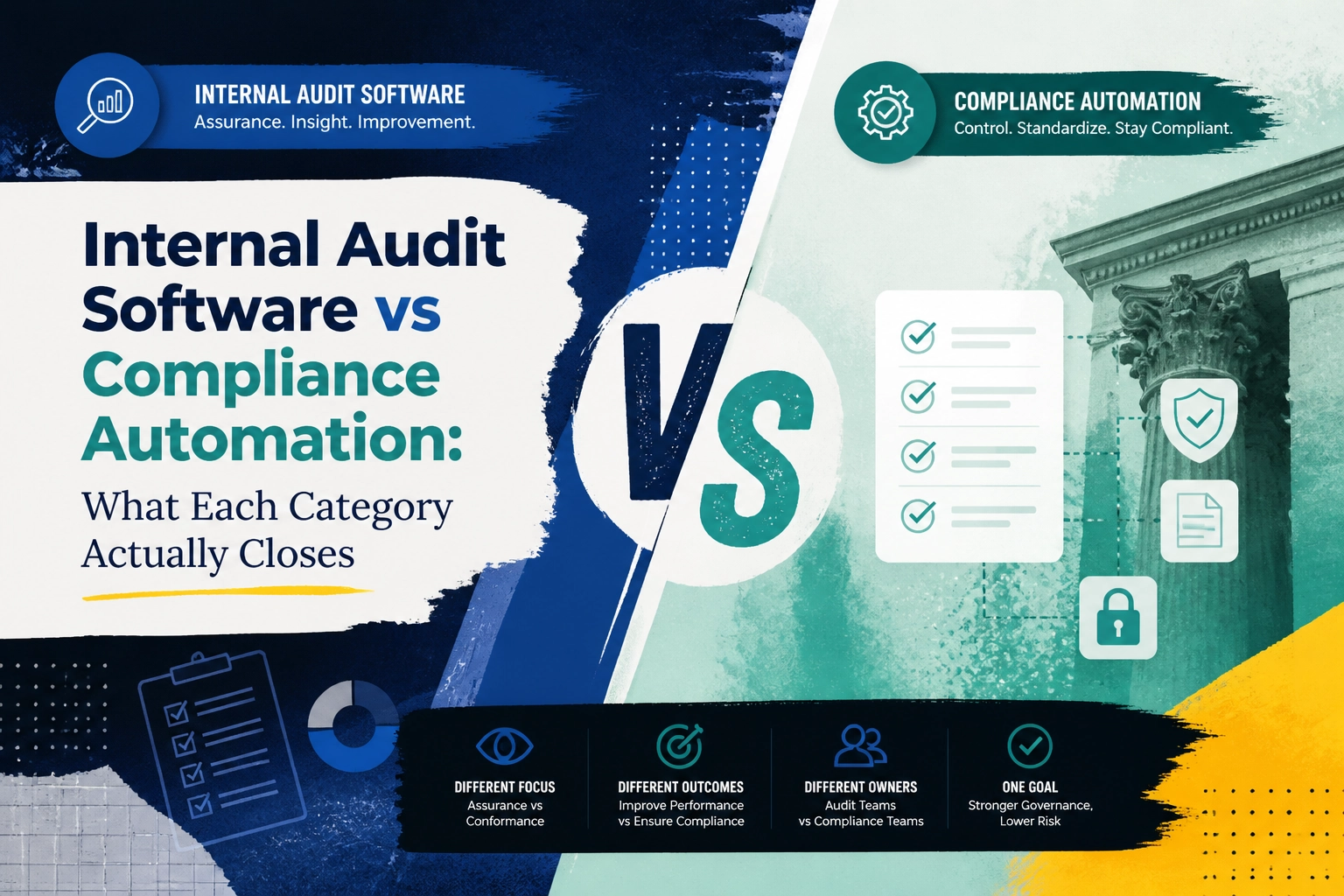
Ask ten buyers what internal audit software does and you will likely get ten answers, several of which are really describing compliance automation. The two category names get used interchangeably in vendor conversations, on procurement shortlists, and in job postings, yet they close entirely different work. Internal audit software manages the engagements you perform: planning, fieldwork, findings, and follow-up. Compliance automation manufactures and organises the evidence for audits performed on you. Buy the wrong one and you inherit a findings register with nothing behind it.
This comparison separates the categories cleanly. It examines why buyers collapse them, what each one actually closes, and the dimensions that genuinely differ. It then applies a decision test this article proposes: who owns the finding after it is raised? From there it covers when each purchase is the right one, what a mature integrated state looks like with a defined handoff, and why the IIA's 2024 Global Internal Audit Standards, with their explicit emphasis on evidencing conformance, raise the evidentiary bar for the internal audit function and, indirectly, for the evidence it consumes. It closes with a practical route to deciding this quarter.
Why Buyers Collapse Two Very Different Software Categories
Buyers searching for "audit and compliance software" routinely end up comparing a findings workflow tool against an evidence library, then wonder why the two demos share so little. Both categories sit next to the word audit, both are bought by risk, compliance or finance, and vendors label themselves, so nobody polices the boundary.
The cost runs both ways. Buy internal audit software when your real problem is evidence collection and you end up with a findings file that cannot be substantiated. Buy compliance automation when you run your own assurance programme and you get a document repository with no engagement plan, fieldwork log or remediation tracking.
The category names in circulation show the confusion: internal audit software, audit management software, compliance audit software. The last is the most misleading of the set, because it names a category that does not stand alone.
This is a category-level comparison, not a vendor ranking. They close different problems rather than competing for the same one. The decision rule set out later is this article's own framing, not a codified industry standard. For platform-level selection criteria, see this audit compliance software buyer's guide.
What Internal Audit Software Actually Closes
Internal audit software is the system of record for work the internal audit function performs: annual planning and risk-based coverage, engagement scoping, workpapers and fieldwork documentation, issue logging, management responses, and follow-up through to closure. The discipline behind it is codified. The Global Internal Audit Standards, published on 9 January 2024, are organised into five domains, 15 principles and 52 standards, each carrying requirements, implementation considerations and considerations for evidencing conformance, according to CohnReznick's April 2024 commentary.
The output faces inward and upward. Its consumers are the chief audit executive, the audit committee, the board and the risk function, not an external certification body. Expect artifacts including an engagement plan, risk assessment and audit universe, workpapers, a findings register, a remediation tracker and an audit committee reporting pack. The defining unit is the engagement: every record hangs off a discrete audit the organisation planned and executed. Checklist tooling sits inside that workflow; for a related read, see this guide to audit checklist software.
What it does not close is continuous evidence. It will not collect configuration screenshots, policy acknowledgements or access reviews on a recurring schedule, which is exactly what a certification auditor asks to see.
What Compliance Automation Actually Closes
Compliance automation tools close the evidence side. They manufacture, collect and organise the proof that frameworks audited against you require, such as ISO 27001, SOC 2, GDPR and NIST, mapping controls to framework requirements and generating or gathering evidence on a recurring schedule. The orientation is outward: certification bodies, external auditors, regulators and enterprise customers running vendor due diligence. The artefacts reflect that: control-to-framework mapping, responses to evidence requests, policy lifecycle records, access review trails, audit-ready report exports, and a timestamped evidence trail. Internally, internal audit gets this as testable raw material rather than as its own work product.
The mechanics distinguish the category. Collection is continuous rather than periodic, integrations pull from the systems that hold the evidence, and overlapping requirements, as shown in AICPA's criteria mapping, let evidence be reused across multiple frameworks. Platforms in this category, DataDoc among them, automate evidence collection and mapping across frameworks; DataDoc describes itself as an AI-powered platform covering 100+ frameworks, including GDPR, ISO 27001, SOC 2, CCPA and NIST, with audit-ready reports and a 14-day free trial with no credit card required, all vendor claims. What it does not close: it does not plan engagements, decide what assurance is needed, or own a finding once raised, because it has no independent function to route findings to.

Side by Side: The Dimensions That Actually Differ
The split sharpens when you line the two categories up on the dimensions buyers rarely compare.
Whose audit it is. Internal audit software runs audits your organisation plans and performs. Compliance automation serves audits performed on your organisation by someone else.
Unit of work. The engagement against the control.
Primary artifact. The workpaper and findings register against the evidence record and control-to-framework mapping.
Rhythm. Periodic campaigns tied to an annual plan against continuous collection on a schedule.
Consumer. Audit committee, board and chief audit executive against certification body, external auditor, regulator and enterprise customer.
Cost of choosing wrong. A findings register you cannot substantiate, or an evidence library nobody is testing.
The overlap is genuine, which is why the confusion is understandable rather than careless. Both categories hold control references and timestamps, and both touch how frameworks require audit documentation. The second line monitors and challenges while internal audit provides independent assurance, with the board overseeing both, a relationship the Three Lines Model sets out for governing bodies. They meet at the evidence trail. They do not share accountability for the finding.
That single distinction is what the next section tests.
The Decision Test: Who Owns the Finding After It Is Raised?
The test below is this article's own framing, not a codified rule. Take one finding and trace it from discovery to closure, asking which system holds the accountability.
If the finding emerged from an engagement your function planned and executed, carrying an audit owner, a management response, a target date and follow-up testing, it belongs in internal audit software.
If it came from a framework assessment or an external audit report and closes when a control configuration changes and evidence is re-collected, compliance automation produced the evidence, while accountability for the control stays with its owner in management.
Consider a finding on access reviews: internal audit raises it, remediation runs through the control environment, and the proof comes from automated evidence collection, such as automating access review evidence. One finding, two systems, one owner.
Feature overlap is real. Accountability is not a feature, and neither is independence or the ability to test your own work.
Run the test in under an hour: list your last ten findings, mark which system holds each at closure, and count. The majority names the category you actually need.
When Internal Audit Software Is the Right Purchase
If most of your last ten findings traced back to engagements you planned yourself, the answer is internal audit software.
The scenario is specific: an organisation running its own risk-based assurance programme, reporting to an audit committee, planning engagements, logging fieldwork, recording findings and tracking remediation to closure. The requirements list gives it away: audit universe, risk assessment and annual plan, engagement templates, workpaper storage, issue tracking with management responses, follow-up scheduling and audit committee reporting.
No engagement model or independence mechanism underlies that kind of programme. The 2024 Global Internal Audit Standards emphasise performance and continuous improvement rather than conformance alone, raising the value of tooling that manages the work, not just documents the outcome.
Shortlist on three criteria: coverage of the IIA standard domains you must evidence, a finding linked to its workpaper, and a follow-up mechanism that cannot be quietly dropped.
That is a legitimate primary purchase, not a compromise. Where evidence production is the constraint, automated evidence gathering across frameworks belongs beside it, but cannot replace it.
When Compliance Automation Is the Right Purchase
The opposite constraint points to compliance automation: your constraint is evidence production, not assurance design.
Picture a company certifying against ISO 27001 or reporting against SOC 2 for the first time, while enterprise security questionnaires pile up. Its requirements list control-to-framework mapping, integrations into systems holding configuration and access data, policy lifecycle management, evidence request workflows, and evidence reuse across overlapping frameworks.
Engagement tooling does not generate the artefacts that certification bodies and external auditors ask to see.
Frameworks such as ISO 27001 and SOC 2 turn on documented evidence of control operation. Producing that evidence on a recurring basis is squarely a compliance automation job. DataDoc states a 14-day no-credit-card trial, a vendor claim; use any trial to validate integration coverage before committing. The regulatory certification guide adds framework context.
Shortlist compliance automation tools on framework breadth, integration depth into your actual stack, export quality for external auditors, and continuous evidence handling. Then test the handoff into internal audit.
The Mature State: Both, With a Defined Handoff
In observed practice, mature teams run both: compliance automation for continuous evidence, internal audit software for engagements. The value sits in the seam, defined in both directions.
Evidence flows from compliance automation, where GDPR audit readiness is a recurring example, into the internal audit engagement as testable raw material. Findings flow back into the control environment as change requests logged against controls. Independence does not block this: internal audit can test second-line evidence without owning its production, and the standards' emphasis on relationships with the first and second lines and with external auditors (per the CohnReznick commentary) supports a working relationship rather than a wall.
The handoff satisfies the standards' evidencing-of-conformance requirement on one side and the certification or external audit evidence requirement on the other, without duplicate collection.
For a smaller function, sequence the build: evidence automation first if external reporting deadlines dominate, internal audit software first if an audit committee mandate and an assurance programme already exist.
The limit is honest: neither category replaces judgement about what assurance is needed. Integration is a workflow question, not a definitional one.
Why the 2024 IIA Standards Raise the Evidentiary Bar
That workflow question has a regulatory trigger. The Global Internal Audit Standards were published on 9 January 2024 and are organised into five domains, 15 principles and 52 standards, as CohnReznick’s 25 April 2024 commentary sets out. Each standard carries requirements, considerations for implementation and considerations for evidencing conformance. The standards make evidencing conformance part of the proof itself rather than a matter of the auditor’s good faith, which is why a repeated evidence trail matters.
That evidencing requirement is what links the two categories: a function required to show conformance continuously benefits from a reliable evidence pipeline, which is where compliance automation earns its place beside internal audit software. The standards still define internal auditing as providing independent, risk-based and objective assurance, advice, insight and foresight to the board and management. Tooling supports that purpose without defining it.
Sourcing is limited. The substantive commentary comes from one advisory source, the standards PDF front matter confirms publication, and no adoption or cycle-time statistics are claimed here.
How to Decide This Quarter
The standards raise the evidentiary bar, so hedge against a function that cannot show its evidence. Where the ownership of your last ten findings sits, rather than where you wish it sat, names the category you need first.
Then write down the single artefact your current systems cannot produce on demand. That artefact names the category to buy first. If it is a workpaper or a findings register, you need internal audit software. If it is a control-to-framework mapping or an evidence trail, you need compliance automation.
Do not accept a demo that showcases the other category's features without producing your artefact. Ask each vendor which engagement, or which framework, the evidence shown was generated for. The answer exposes the category instantly.
If you will eventually buy both, scope the handoff between evidence collection and engagement testing before either contract is signed, not after.
Buy internal audit software when you run assurance; buy compliance automation when assurance is run on you. Mature operations hold both.
Print your artefact list and the ownership question, take them into your next vendor call, and test the category rather than the reputation.
Conclusion
Internal audit software and compliance automation close different work. Internal audit software holds assurance engagements, workpapers, and the findings register, and it answers who owns a finding after it is raised. Compliance automation holds control-to-framework mappings and the evidence trail. The ownership test and the missing-artefact test are the practical way to choose. Do not let a demo that showcases the other category’s features decide for you. Ask which engagement or framework generated the evidence shown. If both categories will eventually be needed, define the handoff between evidence collection and engagement testing before signing either contract. The value is a cleaner purchase decision tied to work the organisation already performs. This quarter, run the ownership test on your last ten findings, write down the one artefact you cannot produce on demand, and take both into your next vendor call. Test the category, not the reputation, and choose the system that closes the work you actually own.
Frequently asked questions
- What is the core difference between internal audit software and compliance automation?
- Internal audit software is the system of record for engagements the internal audit function plans and performs, including planning, workpapers, findings, and follow-up. Compliance automation manufactures, collects, and organises the evidence for audits performed on the organisation by external parties, such as certification bodies, external auditors, regulators, and enterprise customers.
- Why do buyers often confuse the two categories?
- Both categories sit next to the word audit, both are bought by risk, compliance, or finance teams, and vendors label themselves without any boundary being enforced. The category names are also used interchangeably, so buyers end up comparing a findings workflow tool against an evidence library and wonder why the demos share so little.
- What is the decision test proposed in the article?
- The test asks who owns the finding after it is raised. If the finding came from an engagement your function planned and executed, with an audit owner, management response, target date, and follow-up testing, it belongs in internal audit software. If it came from a framework assessment or external audit and closes when control configuration changes and evidence is re-collected, compliance automation produced the evidence while accountability stays with the control owner in management.
- How can I apply the ownership test quickly?
- List your last ten findings, mark which system holds each one at closure, and count. The majority indicates the category you actually need. The article notes this can be done in under an hour.
- When is internal audit software the right purchase?
- It is the right purchase when most of your recent findings came from engagements you planned yourself, such as an organisation running its own risk-based assurance programme and reporting to an audit committee. Key requirements include an audit universe, risk assessment, annual plan, workpaper storage, issue tracking, follow-up scheduling, and audit committee reporting.
Ready to automate your compliance?
Experience the power of AI-driven compliance automation with DataDoc. Transform weeks of work into minutes.