Audit Documentation: What It Is, What Each Framework Requires, and How to Stop Doing It Manually
Learn what audit documentation includes, what ISO 27001, SOC 2, GDPR, and the EU AI Act require, and how automation cuts compliance cycle time by up to 50%.
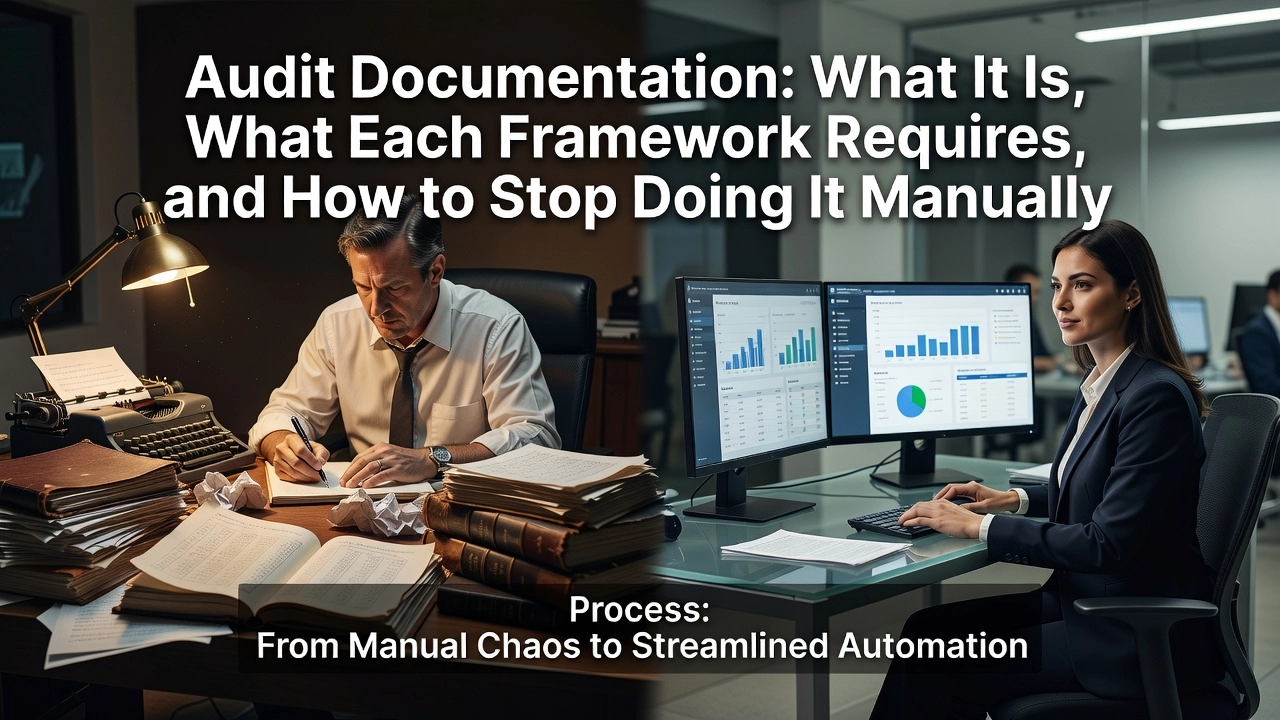
Every auditor knows the feeling: you're buried in spreadsheets, chasing down evidence requests, and manually updating documentation that seems to multiply overnight. The process is exhausting, error-prone, and frankly, unsustainable as your compliance obligations grow.
Audit documentation is the backbone of any successful audit. It provides the evidence trail that proves your controls work, satisfies your auditors, and protects your organisation when things get scrutinised. But here's the problem: most teams are still doing it the hard way.
Whether you're navigating SOC 2, ISO 27001, PCI DSS, or HIPAA, each framework comes with its own documentation expectations. Understanding exactly what's required, and how those requirements differ, is the first step toward building a smarter compliance operation.
In this guide, you'll get a clear breakdown of what audit documentation actually means, a framework-by-framework look at what auditors expect to see, and a practical look at how automation can eliminate the manual grind for good. If you're ready to stop drowning in documentation and start managing it strategically, keep reading.
What Audit Documentation Actually Is
Compliance audit documentation is the structured collection of evidence, records, and artefacts that together demonstrate an organisation's compliance controls exist, are designed appropriately, and are operating effectively. The PCAOB's AS 1215 standard defines it as "the written record of the basis for the auditor's conclusions," covering work performed, evidence obtained, and conclusions reached. This framing matters because it positions documentation not as a filing formality but as the evidentiary foundation on which audit opinions rest. Without it, even a genuinely well-controlled organisation cannot prove its posture to an independent auditor.
The Five Core Components
Audit documentation spans five discrete categories, each serving a distinct evidentiary purpose:
Evidence logs: Screenshots, system exports, and access records proving that controls were active during the specific review period under examination
Control testing records: Documented test procedures and their outcomes, confirming that controls functioned as designed rather than merely existing on paper
Policy documents: Written procedures and standards establishing what controls are required, how they operate, and who is responsible for them
Risk assessments: Documented identification, scoring, and treatment of risks that the control environment is designed to address
Audit trails: Time-stamped activity logs recording who did what and when, providing the chronological backbone of any compliance case
No single artefact type is sufficient on its own. A complete documentation package draws on physical, documentary, and testimonial evidence in combination.
Internal Audit vs. External Certification: Why the Evidence Standard Differs
Internal audit documentation primarily serves management; it supports improvement, risk identification, and governance assurance within the organisation. External certification audits, such as ISO 27001 or SOC 2, require evidence that satisfies an independent third-party auditor forming an opinion for publication or regulatory submission. As Scrut's audit evidence guide notes, external auditors assess whether controls are in place and operating effectively throughout the entire review period, raising the evidentiary bar considerably above what an internal review typically demands.
The Knowledge Gap and the Living Record Problem
Most compliance guidance addresses what controls to implement, not how to document them to a standard that satisfies a live auditor. The result is predictable: analysts discover documentation gaps only when an auditor raises a finding, at exactly the point when remediation is most costly and disruptive. This trial-and-error learning cycle is largely avoidable, yet it persists because foundational definitions are routinely skipped in training materials and framework guides.
Equally important is recognising that audit documentation is not a one-time deliverable produced in the weeks before an assessment. Auditors look for evidence that controls operated continuously throughout the review period, not at a single point in time. That requires a repeatable, maintained collection process running between audit cycles, updated as systems change, risks evolve, and new regulatory obligations emerge.
What Audit Documentation Must Include in 2026
Audit documentation in 2026 is no longer a simple folder of screenshots and signed policies. The regulatory landscape has expanded dramatically, and what auditors expect to find, organised and traceable, now spans a significantly broader set of record types.
The universal components that appear across virtually every major framework, including SOC 2, ISO 27001, HIPAA, GDPR, and PCI DSS, remain the foundational starting point. Every compliance programme must maintain current asset inventories covering hardware, software, and data assets; access control logs recording who accessed which systems and under what authorisation; vulnerability scan results tied to remediation timelines; incident response records documenting detection, containment, and recovery; vendor and third-party agreements capturing supply chain risk assessments; and data processing records detailing how personal and regulated data is collected, stored, and shared. These six categories form the baseline evidence set that auditors across all major frameworks expect to find ready and current.
AI transparency records are the most significant new documentation category entering audit scope in 2026. The EU AI Act is the first comprehensive legal framework on AI worldwide, and its obligations are now actively enforcing. Rules for general-purpose AI models became applicable in August 2025, with high-risk AI system requirements, covering employment, credit, education, and critical infrastructure, taking full effect in August 2026. Under Articles 11 and 13, organisations must document algorithmic logic descriptions, model training data sources, bias assessments, explainability records, and tamper-evident decision audit trails. Non-compliance penalties reach up to 15 million euros or 3% of global annual turnover per violation. U.S. state AI statutes in Colorado, Texas, and Illinois have been enforcing in parallel from January through June 2026, adding jurisdiction-specific documentation layers on top of the EU framework. Preparing for EU AI Act compliance using ISO 42001 is increasingly recommended as a bridge approach for organisations managing multi-framework AI documentation obligations simultaneously.
Documentation obligations now extend beyond managed server environments. Edge devices, IoT nodes, and serverless functions increasingly process regulated data outside traditional perimeters, and audit documentation must capture asset inventories, access logs, and decision records from all of these environments. Shadow AI usage compounds this challenge, as unmanaged tools and personal logins create documentation gaps that surface directly during audit cycles.
The EU Data Act, effective September 12, 2025, adds a further layer. Organisations must now document how data generated by connected devices and services is shared and accessed across jurisdictions, expanding both data processing records and vendor agreement categories in ways that many compliance teams have not yet fully mapped.
The global stakes make these gaps genuinely serious. According to IAPP data from January 2025, 144 countries have enacted national data privacy laws, now covering 82% of the world's population. A single documentation failure no longer carries local risk; it carries simultaneous exposure across multiple regulatory regimes. Getting the documentation scope right in 2026 is not a procedural nicety. It is a prerequisite for operating globally.
Framework-by-Framework Audit Documentation Requirements
Different compliance frameworks carry their own documentation logic, and understanding exactly what each one demands is the foundation of an efficient audit preparation strategy. The following breakdown covers the major frameworks compliance teams encounter in 2025 and 2026, along with the specific artefacts auditors will expect to find.
1. ISO 27001: Continuous Evidence, Not a Compliance Sprint
ISO 27001 certification requires a formally documented Information Security Management System, and the most common readiness mistake organisations make is treating documentation as a one-time assembly exercise. Auditors do not simply want to see that policies exist; they want evidence that controls have been operating throughout the certification period. Core artefacts include the ISMS scope document, Statement of Applicability (SoA), risk treatment plan, internal audit records, and management review minutes. The SoA in particular must reflect genuine decision-making, with documented justifications for each included or excluded control from Annex A. Risk treatment plans must link identified risks to specific controls, owners, and review dates. Management review minutes serve as evidence that senior leadership is actively engaged with the ISMS, not simply aware of it.
2. SOC 2: Full-Period Evidence Coverage
SOC 2 assessments, governed by the AICPA's Trust Services Criteria, come in two forms. Type I evaluates whether controls are suitably designed at a single point in time, while Type II evaluates whether those controls operated effectively across the full audit period, typically 6 or 12 months. Type II is the standard most enterprise customers and procurement teams require. Documentation must include policy documents mapped to each applicable Trust Services Criterion, a current system description, change management logs, logical access review records, and vendor management documentation. The evidence population requirement is where many organisations fall short; holding a well-written access control policy is not sufficient if you cannot produce access review logs demonstrating that reviews were conducted every quarter throughout the audit window.
3. GDPR: Granular Records for Every Processing Activity
GDPR imposes some of the most detailed documentation obligations of any major framework, and the breadth of what supervisory authorities can request on short notice makes live record maintenance, rather than retrospective reconstruction, essential. Records of Processing Activities (RoPAs) must document every distinct processing activity, covering the purpose, categories of data, recipients, retention periods, and cross-border transfer mechanisms. Data Protection Impact Assessments are required for high-risk processing activities, and the threshold for "high risk" covers a wide range of modern data uses, including large-scale profiling and systematic monitoring of public spaces. Breach notification logs must record every incident considered under the 72-hour notification obligation, including those where notification was ultimately not required and the reasoning behind that decision. Consent management records must demonstrate that consent was freely given, specific, and unambiguous, with a clear withdrawal mechanism. With fines reaching up to 10% of global turnover under the most severe provisions, incomplete GDPR documentation carries direct financial exposure.
4. NIST CSF and NIST SP 800-53: Traceability From Control to Evidence
The NIST Cybersecurity Framework and SP 800-53 Rev 5 are the dominant documentation standards for US federal contractors, financial institutions, and organisations seeking to demonstrate structured cybersecurity governance. Documentation requirements centre on System Security Plans, which describe how each control is implemented within a specific environment, contingency plans covering business continuity and disaster recovery procedures, and continuous monitoring outputs that show controls are performing as intended over time. The critical discipline within NIST documentation is traceability; every control must link to supporting evidence, and that evidence must be dated, versioned, and attributable to an accountable owner. The NIST AI Risk Management Framework, updated to address generative AI and supply chain vulnerabilities, is now adding a further documentation dimension for organisations deploying AI systems within NIST-governed environments.
5. EU AI Act: A New Documentation Category Entirely
The EU AI Act introduces documentation obligations that have no direct precedent in traditional cybersecurity frameworks. Requirements are scaled to risk tier. High-risk AI systems require technical documentation covering the model's intended purpose, training data provenance, validation methodology, performance metrics, human oversight mechanisms, and post-market monitoring logs. General-purpose AI models carry transparency obligations, and the most capable GPAI models face additional systemic-risk documentation requirements. The August 2026 enforcement milestone for high-risk system governance is active, making this an immediate preparation priority. Notably, comparing the EU AI Act with NIST and ISO 42001 reveals significant overlap in risk assessment and human oversight documentation, which forward-thinking teams are already mapping to avoid producing duplicate artefacts across frameworks.
6. Multi-Framework Compliance: Build a Cross-Framework Control Matrix
Organisations pursuing two or more of these frameworks simultaneously face a compounding documentation burden unless they approach control mapping strategically. A cross-framework control matrix, which maps each control to every framework that requires it, is one of the highest-value artefacts a compliance team can build. Access management, for example, appears as ISO 27001 Annex A control A.5.15, SOC 2 CC6, and GDPR Article 32; a single well-evidenced control can satisfy all three if the matrix is structured correctly. The AI governance layer adds further overlap: ISO 42001, the NIST AI RMF, and the EU AI Act all converge on risk assessment, human oversight, and technical documentation requirements, as detailed analysis of these converging AI governance frameworks confirms. Platforms like DataDoc are designed precisely for this multi-framework reality, generating audit-ready documentation across 100 or more frameworks from a single evidence base, eliminating the redundant effort that consumes more than half of most compliance teams' working time.
Common Audit Documentation Failures That Cause Rejections
Even as compliance statistics for 2026 show that 56% of compliance and risk professionals rank data privacy, protection, and security as their top priorities, manual documentation processes remain the operational norm inside most compliance teams. That gap between stated priority and actual practice is precisely where audit rejections originate. Understanding the specific failure modes, before an auditor flags them, is the most direct way to protect certification timelines and avoid costly remediation cycles.
1. Stale or Point-in-Time Evidence
Submitting a single screenshot captured the day before an audit submission is one of the most common and consequential mistakes a compliance team can make. Auditors reviewing frameworks such as SOC 2 or ISO 27001 increasingly request evidence that demonstrates continuous control operation across the entire review period, not a moment-in-time capture that tells them nothing about what happened in the preceding eleven months. The shift toward continuous monitoring in audit practice is now well established heading into 2026, and tolerance for isolated log exports or periodic screenshots is declining sharply. The PCAOB's revised standard AS 1215, effective December 15, 2026, formalises expectations around temporal completeness of audit evidence, signalling that this trend is being codified into hard regulatory requirements. Compliance teams that rely on last-minute evidence assembly are structurally exposed to this failure.
2. Undocumented Exceptions and Deviations
When a control is temporarily disabled, bypassed, or modified without a corresponding written risk acceptance or compensating control record, auditors do not interpret this charitably. In the absence of documentation, the working assumption is that the control never operated as described, not that a temporary lapse occurred and was managed responsibly. This is a leading cause of audit findings across financial services, SaaS, and regulated manufacturing environments. Recurring process gaps and weak spots in documentation consistently surface when organisations conduct post-audit root-cause analyses, and exceptions that went unrecorded account for a disproportionate share of those findings. Every deviation needs a paper trail: a date, a rationale, an approval, and a compensating measure.
3. Incomplete Vendor Documentation
Third-party and supply chain compliance records have become a discrete regulatory focus in 2026, and missing vendor documentation is flagged immediately by auditors across virtually every major framework. Absent SLAs, outdated vendor risk assessments, and missing subprocessor agreements each represent a documented gap in the control environment. Regulators are now requiring more granular third-party oversight documentation, and vendor-related issues were among the most recurring themes in 2025 internal audits and independent reviews. Organisations that treat vendor documentation as secondary to internal controls documentation are consistently caught off guard when auditors request supply chain evidence.
4. Policy-Evidence Misalignment
A written policy that states quarterly access reviews are conducted, when system logs show the review occurred only once during the audit period, is a direct and verifiable cause of rejection. This misalignment typically develops when policies are updated to reflect aspirational or newly mandated practices without simultaneously updating the controls or evidence-collection workflows that are supposed to demonstrate them. Root-cause analyses from 2025 audit cycles consistently identified training and documentation weaknesses, including policies that had outpaced actual operational execution, as primary drivers of repeat findings.
5. Missing Retention Metadata
Evidence submitted without timestamps, system identifiers, or chain-of-custody information is routinely challenged because auditors must be able to verify both authenticity and integrity. AS 1215) explicitly formalises documentation completeness requirements, including sufficient identification of what was reviewed and when. PCAOB enforcement activity in 2025 confirmed that alleged violations of auditing standards remained a prominent category, with documentation deficiencies carrying enforcement consequences rather than simple procedural notes. Every piece of evidence in an audit package should carry provenance information that allows an independent reviewer to confirm it is genuine, unaltered, and relevant to the stated control period. Without that metadata, even substantively accurate evidence can be disqualified.
How Long to Retain Audit Documentation by Framework
Knowing what to document is only half the compliance equation. Knowing how long to keep it determines whether that documentation will actually protect your organisation when regulators come calling. Retention obligations vary significantly across frameworks, and conflating them is a common source of audit exposure.
GDPR
GDPR does not prescribe a single fixed retention period for compliance documentation. The accountability principle under Article 5(2) requires organisations to demonstrate compliance on an ongoing basis, which means documentation must exist and remain accessible for as long as it is needed to substantiate that position. The Article 30 Record of Processing Activities must be kept current at all times; it is a living document, not a snapshot. For data breach records specifically, the working industry standard is a minimum of three years, aligned with regulatory investigation windows that supervisory authorities typically operate within. Given that GDPR violations can attract fines of up to 4% of global annual revenue, treating documentation retention as an administrative formality rather than a live financial risk is a costly miscalculation.
ISO 27001
ISO 27001 takes a principles-based approach to retention. The standard requires organisations to determine their own documented retention schedules rather than imposing universal minimums. In practice, audit programme records and internal audit results are retained for a minimum of three years, which reflects the structure of the certification cycle: annual surveillance audits followed by a full recertification audit at year three. Retaining three years of evidence means your organisation can demonstrate a consistent pattern of control effectiveness rather than a single point-in-time snapshot, which is precisely what certification bodies expect to see.
SOC 2
AICPA guidance underpinning SOC 2 does not specify a fixed retention period for supporting audit evidence. Industry practice, shaped by enterprise contractual obligations and legal hold requirements, converges firmly on a minimum of five years. This aligns with the multi-year enterprise agreements in which SOC 2 reports are frequently cited as a contractual assurance mechanism. The SOC 2 CC7.2 control on system monitoring is directly relevant here, as AI audit logging requirements under frameworks including SOC 2 and FedRAMP continue to grow more demanding. Five years is the floor, not the ceiling, for organisations operating in regulated industries.
NIST SP 800-53 and FedRAMP
For U.S. federal environments and FedRAMP-authorised systems, NIST SP 800-53 Rev. 5 takes a more prescriptive approach. System security plans and continuous monitoring outputs are generally retained for the life of the system plus three years. Specific record categories, including audit logs and incident reports, carry a minimum three-year retention obligation under NIST guidelines. FedRAMP AU-2 and AU-12 controls govern audit event requirements and are non-negotiable for cloud service providers seeking or maintaining federal authorisation.
EU AI Act
The EU AI Act carries the most demanding retention obligation of any framework addressed here. Under Article 12, providers of high-risk AI systems must retain technical documentation for ten years after the system is placed on the market or put into service. Full enforcement for high-risk AI system obligations begins August 2, 2026. Deployers, as distinct from providers, must retain operational logs for a minimum of six months, though sector-specific rules take precedence; financial services deployers should default to seven years under MiFID II standards. Non-compliance with high-risk AI requirements can trigger penalties of up to 4% of global annual turnover.
Build a Retention Schedule Matrix
The most practical step you can take now is to build a retention schedule matrix that maps each document type to its framework-specific minimum retention period, the required storage format (immutable, encrypted, tamper-evident), and a designated document owner. This matrix itself becomes an auditable artefact, demonstrating that your organisation has engaged seriously with its obligations rather than leaving retention decisions to chance. Platforms like DataDoc can support this by maintaining framework-aligned documentation structures that make retention obligations visible and enforceable across your entire compliance programme.
Manual Audit Documentation vs. Automated: A Before and After
The gap between manual and automated audit documentation is not a matter of preference. It is a measurable operational difference that affects certification timelines, team capacity, and regulatory risk.
Before: The Manual Documentation Reality
Compliance teams operating under manual processes spend more than 50% of their working time chasing documents, gathering screenshots, and completing redundant reports. The workflow is familiar and exhausting in equal measure: logging into AWS or Azure to screenshot configuration settings, pulling access logs from identity providers, tracking down policy documents scattered across shared drives, and then manually mapping everything to controls in a spreadsheet. For a 50-person SaaS company pursuing ISO 27001 and SOC 2 simultaneously, a single audit cycle can consume between 200 and 400 hours of staff time and add four to eight weeks to the certification timeline.
Evidence collection under this model is almost entirely reactive, concentrated in the weeks immediately before an audit window opens. The result is documentation stored across email chains, Jira tickets, and spreadsheets that auditors cannot easily verify or trace to source systems. The consequences are significant: 30 to 50% of manually collected evidence is flagged as incomplete or unclear during review, and between 20 and 30% of first-time SOC 2 audits fail outright due to insufficient evidence. Each control requires approximately 30 minutes just to locate the relevant files, before any verification work begins.
After: What Automated Evidence Collection Changes
Automated and AI-powered evidence collection works on a fundamentally different logic. Platforms connect directly to cloud infrastructure, SaaS tools, and identity providers via API integrations, collecting evidence continuously rather than in reactive bursts before an audit. Evidence arrives timestamped, categorised, and mapped to specific controls automatically. What previously required weeks of coordination can be compressed into hours, with audit-ready reports generated in minutes rather than compiled manually over months.
The operational arithmetic is stark. Manual evidence effort falls by up to 90% under automation, and audit preparation compresses from hundreds of hours to 20 to 40 hours per cycle. Automation also enables a collect-once, use-many approach: evidence gathered against one framework maps simultaneously to others, which resolves the multi-framework documentation burden that breaks manual processes entirely. For a team pursuing ISO 27001 and SOC 2 together, this is not a marginal efficiency gain. It is a structural change in how compliance resources are allocated.
The Emergence of Agentic AI in Compliance
Beyond automated collection, the frontier has shifted toward agentic AI, where AI agents autonomously categorise incoming evidence, identify control gaps, draft policy documents, and flag deviations in real time. Rather than simply storing evidence, these systems actively interpret it, surfacing misconfigurations or missing artefacts before an auditor ever sees the documentation set. Compliance shifts from a reactive annual exercise to a continuous operational function, with the control environment visible at any point rather than reconstructed under audit pressure.
Quantifying the Impact
Automation reduces overall compliance cycle time by up to 50%. For an organisation simultaneously targeting ISO 27001 and SOC 2, that reduction translates directly into lower staff costs, faster time to certification, and materially reduced risk exposure during the gap period. The staff cost alone for a manual audit cycle runs to £30,000 to £60,000 in fully loaded personnel time; compression to 20 to 40 hours changes the economics of compliance investment substantially.
DataDoc's platform automates evidence collection and generates audit-ready reports across 100+ frameworks, including GDPR, ISO 27001, SOC 2, CCPA, and NIST. Teams currently benchmarking their manual process against automation have access to a 14-day free trial with no credit card required, making it straightforward to measure the before and after contrast directly against their own documentation workflows.
Building a Multi-Framework Audit Documentation Strategy
Managing compliance across multiple frameworks simultaneously requires a deliberate architectural approach to your audit documentation programme. The following five principles form the operational backbone of a strategy that scales without multiplying your workload.
1. Begin With a Control Mapping Exercise
Before collecting a single piece of evidence, identify where your active frameworks share requirements. Access control obligations, for example, appear in ISO 27001 Annex A.9, SOC 2 CC6, and NIST AC-2 simultaneously. A quarterly access review log, properly formatted, can satisfy all three obligations in a single artefact. This is not a minor efficiency gain; it is the difference between a documentation programme that compounds your workload and one that consolidates it. Reviewing SOC 2 controls mapped to NIST CSF illustrates how SOC 2's nine Common Criteria align with NIST CSF 2.0's six functions across governance, detection, and response categories. Systematic mapping must precede evidence collection, not follow it. Organisations that skip this step build duplicate evidence libraries by default and pay for that redundancy during every audit cycle.
2. Assign Ownership at the Control Level, Not the Framework Level
Framework-level ownership creates duplication and accountability gaps. When one person owns the ISO 27001 access control requirement and a different person owns the SOC 2 CC6 requirement, both parties collect overlapping evidence independently, neither has full visibility, and auditors encounter inconsistencies between the two records. Assigning a single owner per control eliminates this fragmentation. That owner is responsible for evidence collection, maintenance, and readiness across every framework the control feeds into. A RACI model applied at the control level, defining who is Responsible, Accountable, Consulted, and Informed, provides the governance structure that makes this ownership assignment auditable in itself. Clear control-level ownership is one of the most reliable predictors of clean audit outcomes.
3. Implement Continuous Monitoring for High-Risk Controls
Point-in-time evidence collection leaves the gaps between audit cycles unmonitored and undocumented. Misconfigured cloud storage buckets, expired TLS certificates, and lapsed access reviews are among the most frequently cited audit findings, and all three can exist undetected for months under a manual review cadence. Continuous monitoring tools flag these conditions automatically, before an auditor encounters them as findings. NIST SP 800-137 formalises this approach through its Information Security Continuous Monitoring framework, stratifying monitoring frequency by risk impact so that higher-risk controls receive more frequent automated assessment. In practical terms, this means your documentation programme captures exceptions in real time rather than discovering them during pre-audit preparation.
4. Prepare for the 2026 Multi-Framework Intensification
The regulatory stack organisations must document across simultaneously now includes GDPR, the EU AI Act, U.S. state AI laws enforcing between January and June 2026, China's PIPL, NIS2, CMMC, and sector-specific standards. As of January 2025, 144 countries have enacted national data privacy laws covering 82% of the global population. Manual documentation approaches cannot absorb this obligation without proportional headcount increases. Each new framework added to the stack multiplies evidence requirements unless your control mapping and ownership architecture is already in place. Organisations that delay building this infrastructure until a new framework reaches its enforcement date will face both a documentation backlog and an imminent audit deadline simultaneously.
5. Understand the Financial Stakes of Getting Documentation Wrong
The average cost of a data breach reached $4.45 million in 2023, according to IBM research cited by Akitra. That figure does not include regulatory penalty exposure. GDPR fines can reach up to 4% of global annual turnover for serious violations, with Article 83(4) providing a specific penalty pathway for documentation and procedural failures independent of any underlying security incident. U.S. state AI laws add tiered damages calculated by the number of affected individuals. Audit documentation failures that produce rejections, findings, or certifications delays carry compounding commercial consequences, including lost customer contracts and re-audit costs. A documentation strategy built on the principles above is not a compliance formality; it is a direct risk mitigation investment with a calculable return.
Conclusion: Make Audit Documentation a Continuous Asset, Not a Last-Minute Sprint
Audit documentation has crossed a threshold. It is no longer a periodic exercise completed in the weeks before a scheduled audit; it is a continuous operational requirement that runs parallel to every process, system change, and data flow in your organisation. With 144 countries now enforcing national data privacy laws and frameworks like the EU AI Act demanding algorithmic transparency documentation, the expectation from regulators is clear: evidence must be current, traceable, and always available.
The practical steps forward are straightforward. Conduct a documentation gap assessment against every active framework your organisation operates under. Build a retention schedule matrix that maps each document type to its required retention period by framework. Assign control-level ownership so accountability is embedded in your team structure, not assumed. Finally, evaluate honestly whether your current tooling can support continuous evidence collection or whether it leaves your team chasing screenshots and filling redundant reports, as more than 50% of compliance professionals currently do.
Teams ready to move from reactive documentation to an always-audit-ready posture can start with DataDoc's 14-day free trial, no credit card required, with coverage across 100+ frameworks from day one.
Ready to automate your compliance?
Experience the power of AI-driven compliance automation with DataDoc. Transform weeks of work into minutes.