Access Control Automation Explained for Compliance Teams
Learn how access control automation reduces compliance risk, satisfies ISO 27001, SOC 2, NIST, and GDPR requirements, and eliminates manual access review overhead.
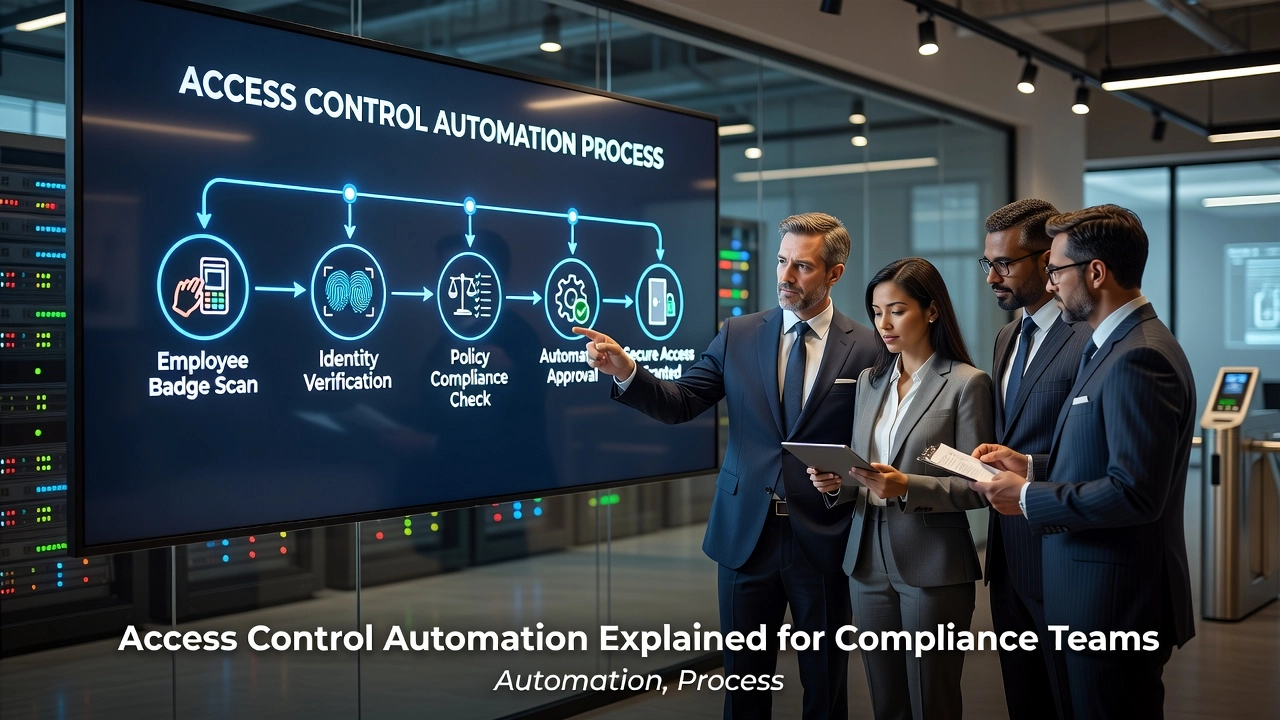
Every few months, another headline surfaces about a data breach traced back to excessive user permissions or an overlooked access policy. For compliance teams, these stories are not just cautionary tales; they represent the constant pressure of managing who has access to what, and proving it to auditors on demand.
This is where access control automation becomes a critical advantage rather than simply a technical convenience. When organisations automate the processes behind granting, reviewing, and revoking system access, compliance teams gain something invaluable: consistent, auditable control without the administrative burden of manual oversight.
In this analysis, we will break down how access control automation actually works, why it matters for regulatory frameworks like SOC 2, ISO 27001, and HIPAA, and what compliance teams should evaluate when assessing their current approach. Whether your organisation is just beginning to formalise its access governance or looking to strengthen an existing programme, understanding the mechanics and compliance implications of automation will help you make more informed, strategic decisions. Let us start with the fundamentals.
What Access Control Automation Actually Means (and What It Does Not)
Before diving into strategy, tooling, or compliance mapping, it is worth being precise about what "access control automation" actually refers to, because the phrase is genuinely easy to misread. A search for "access" on any major platform will surface Microsoft Access database software, physical door-lock systems, and healthcare marketplaces in equal measure. None of those are the subject here. In information security and compliance, access control automation refers specifically to the use of software-driven processes to enforce, monitor, and continuously manage who can access which digital resources, under what conditions, and with what level of privilege, across an organisation's IT environment and compliance programmes.
The Core Concept
At its most precise, access control automation means replacing manual, human-initiated decisions about resource access with policy-based, software-enforced rules that operate without requiring routine human intervention. This spans Identity and Access Management (IAM), Role-Based Access Control (RBAC), Privileged Access Management (PAM), and automated user provisioning and deprovisioning workflows. When a new employee joins, an automated provisioning workflow assigns the correct system permissions based on their role, without an IT administrator manually processing a ticket. When that employee leaves, deprovisioning triggers immediately rather than sitting in a queue, eliminating the orphaned account risk that regulatory frameworks such as ISO 27001 Annex A.5.18 and SOC 2 CC6.2 specifically target.
Where It Sits Within the IAM Ecosystem
Access control automation does not exist in isolation. It operates as a functional layer within the broader IAM ecosystem, which includes Identity Governance and Administration (IGA) for managing the lifecycle of digital identities, PAM for securing elevated and privileged credentials, and directory services such as Microsoft Active Directory or Okta for authenticating and organising user identities. Automation connects these components, enabling event-triggered policy enforcement, scheduled access certification cycles, and machine-generated audit evidence that can be pulled directly into compliance reports.
Automated vs. Basic Access Control
The critical distinction between basic access control and automated access control lies in continuity and evidence generation. Basic access control is largely a point-in-time exercise: permissions are set, reviewed periodically, and documented manually. Automated access control introduces continuous enforcement, real-time anomaly flagging, and structured audit trails produced by the system itself rather than reconstructed by a compliance analyst ahead of an audit.
This distinction matters enormously to three specific groups: compliance managers preparing for SOC 2 or ISO 27001 certification, IT security leads managing a growing SaaS stack where manual reviews simply cannot keep pace with change velocity, and GRC teams required to demonstrate access governance simultaneously across multiple regulatory frameworks. For these buyers, automation is not a convenience; it is a structural requirement for maintaining audit readiness at scale.
Why Manual Access Control Is a Compliance Liability
Understanding why manual access control creates compliance risk requires looking at the specific failure modes that emerge when human processes are responsible for tasks that demand precision, consistency, and speed at scale. Each failure mode compounds the others, and together they represent a systemic liability that grows more severe as organisations mature.
The Orphaned Account Problem
When an employee resigns, is terminated, or moves into a different role, their access rights should be deprovisioned immediately. In practice, manual deprovisioning depends on a reliable handoff between HR and IT, a process that routinely breaks down. Offboarding checklists get missed, tickets go unresolved during busy periods, and role-change notifications never reach the right administrator. The result is orphaned accounts: active credentials belonging to former employees that persist in live systems for weeks or months after departure. These accounts represent an open door, and because they belong to users who no longer have legitimate reasons to log in, any activity through them is inherently suspicious and often goes undetected. For organisations seeking ISO 27001 certification or SOC 2 compliance, documented evidence of timely deprovisioning is not optional; auditors expect it, and gaps create immediate findings.
Privilege Creep: The Silent Accumulator
Orphaned accounts are at least visible in principle, because they belong to people who have left. Privilege creep is harder to see because it accumulates invisibly across the accounts of active users. As employees change roles, take on project responsibilities, or gain temporary access to complete a task, their permission sets expand. Without automated periodic reviews to right-size those permissions, users end up holding access far beyond what their current role justifies. Research consistently shows that a significant proportion of active users within any organisation hold more access than their job function requires. Over time, this excess access creates a broad attack surface, and it concentrates risk in accounts that appear legitimate. Neither the user nor the IT team necessarily flags the issue, meaning the exposure may not surface until an audit or, worse, a breach. Frameworks including NIST SP 800-53 and SOC 2 CC6.1 explicitly require least-privilege enforcement and periodic access certification precisely because privilege creep is so predictable.
What the Data Confirms About Credential Risk
The consequences of poor access governance are not theoretical. The Verizon Data Breach Investigations Report consistently identifies stolen and misused credentials as one of the leading causes of confirmed data breaches year over year. Credential misuse appears across industries, company sizes, and attack types, which reflects the fact that access governance failures are systemic rather than isolated. When an orphaned account is compromised or a privilege-crept user's credentials are stolen, the attacker inherits access that was never properly constrained in the first place. The financial and reputational consequences, including regulatory fines under GDPR, breach notification costs, and remediation expenditure, far exceed what proactive automation would have cost.
Audit Evidence and the Spreadsheet Problem
Manual quarterly access reviews conducted via spreadsheet create a specific and increasingly serious audit risk. They are slow to compile, prone to error, and difficult to evidence in a way that satisfies auditors who are looking for completeness, timeliness, and a clear approval trail. Auditors reviewing access certification records under SOC 2 or ISO 27001 expect to see not just that a review happened, but when each decision was made, by whom, and what happened to flagged accounts. Spreadsheets rarely capture this level of detail consistently, and gaps in that evidence can delay or outright block certification.
The Scalability Wall
A team of fifty people can manage access reviews manually, though poorly. A two-hundred-person organisation running forty SaaS applications cannot. As headcount and tooling grow, the matrix of users, roles, and permissions expands faster than any manual process can track. Every month without automation adds to a compounding compliance debt, and the more access rights accumulate without review, the harder and more expensive the remediation becomes. Organisations at their growth inflection point are particularly exposed because the processes built for a smaller team have not yet been replaced, but the risk profile has already multiplied.
What Compliance Frameworks Actually Require from Access Control
Compliance frameworks do not leave access control to interpretation. Each major standard contains explicit, enforceable requirements that define what organisations must implement, document, and demonstrate to auditors. Understanding those requirements at a technical level is essential for any compliance team evaluating where automation adds the most value, because the controls themselves often describe automated processes in everything but name.
ISO 27001 and the Access Control Clause
ISO 27001's access control requirements, historically grouped under Annex A.9 and restructured in the 2022 revision under controls 5.15 through 5.18, establish a comprehensive framework for managing who can access what, under what conditions, and for how long. Organisations are required to define and enforce access control policies, manage user access throughout the full identity lifecycle, assign user responsibilities for protecting authentication information, and restrict access to systems and applications based on business need. Critically, the standard requires periodic reviews of access rights, meaning organisations cannot simply provision access and move on. They must demonstrate, with documented evidence, that access rights have been reviewed at defined intervals and that inappropriate access has been revoked. Each of these obligations maps precisely to an automation capability: lifecycle management replaces manual HR-IT coordination; periodic reviews become scheduled certification workflows; policy enforcement becomes role-based access logic applied at provisioning.
SOC 2 CC6: Three Controls, Three Automation Workflows
The AICPA's SOC 2 Trust Services Criteria address logical access through criteria CC6.1, CC6.2, and CC6.3, each targeting a distinct phase of the access lifecycle. CC6.1 establishes the baseline requirement that access to information assets is limited to authorised individuals, processes, or devices, and that those access rights are commensurate with the individual's role and responsibilities. This is not a policy commitment; it is an operational state that must be verifiable at the point of audit. CC6.2 extends this by requiring that new user access follows a formally defined provisioning process, including documented authorisation before access is granted. CC6.3 then closes the loop by requiring that access is removed promptly when it is no longer needed, covering employee departures, role changes, and contract terminations. Taken together, these three criteria describe a continuous provisioning and deprovisioning cycle that, when executed manually, is consistently late, inconsistently documented, and expensive to evidence at audit time.
NIST SP 800-53 and the AC Family
NIST SP 800-53 Revision 5 dedicates an entire control family to access control, and the language within that family is among the most operationally specific of any framework. AC-2, which governs account management, explicitly requires that organisations employ automated mechanisms to support account management activities including account creation, modification, enabling, disabling, and removal. This is not a recommended enhancement; in many federal and regulated environments, the automated mechanism requirement is a baseline expectation. AC-3 enforces authorised access in accordance with approved authorisations, AC-5 mandates separation of duties to prevent any single individual from holding conflicting privileges, and AC-17 governs remote access with requirements for documentation, monitoring, and control. Together, these controls describe an access environment that can only be operated consistently at scale when the underlying workflows are automated.
GDPR Article 25 and the Legal Weight of Least Privilege
GDPR Article 25, which establishes data protection by design and by default, elevates least-privilege access from a technical best practice to a legal obligation. The article requires that, by default, only personal data that is necessary for each specific processing purpose is made accessible, and that such data is not made available to an indefinite number of persons without individual intervention. In practical terms, this means that over-provisioned access to personal data is not merely a security risk; it is a potential regulatory violation. For organisations subject to EU data protection law, every user who holds broader access to personal data than their role requires represents measurable compliance exposure.
The Audit Evidence Reality
Across all of these frameworks, auditors converge on a consistent set of artefacts: access matrices showing current permissions mapped to roles, provisioning logs with timestamps and approver identities, deprovisioning records confirming when and how access was removed, access certification sign-off records from periodic reviews, and role change histories linking access modifications to authorised business events. The challenge for organisations relying on manual processes is that these artefacts must typically be assembled reactively, at audit time, from disparate systems. Automation platforms generate these records continuously as a byproduct of normal operations, which fundamentally changes the audit preparation timeline from weeks to minutes.
Core Access Control Automation Capabilities Explained
Access control automation is not a single feature but a collection of interconnected capabilities that, taken together, replace the fragmented, human-dependent processes that create compliance gaps. Understanding each capability individually makes it easier to evaluate what your organisation currently has in place and where the most significant exposure points remain.
Automated User Provisioning
When a new employee joins an organisation, or when a contractor begins an engagement, the clock starts immediately. Every day that passes without appropriately scoped system access represents lost productivity, and every manual IT ticket introduced into that process adds latency and the possibility of error. Automated user provisioning solves this by connecting HR system events directly to identity governance workflows. When a hire event is recorded in an HRIS such as Workday or SAP SuccessFactors, the provisioning engine reads the role, department, and employment type associated with that record, maps those attributes to a pre-defined role baseline, and automatically creates accounts and assigns permissions across every integrated system simultaneously. The new user arrives on day one with access to exactly what their role requires, nothing more. This is not simply a convenience improvement; it is a compliance control. SOC 2 CC6.1 and ISO 27001 Annex A.8.2 both require that access be granted based on documented authorisation, and automated provisioning creates that documented record as a byproduct of the workflow itself.
Automated Deprovisioning
If provisioning represents the opening of an access lifecycle, deprovisioning is the closing, and it is where manual processes fail most visibly. Orphaned accounts, those belonging to former employees or contractors whose access was never revoked, represent one of the most consistently cited identity risk categories in security research. Manual offboarding depends on HR teams notifying IT teams, IT teams working through system-by-system checklists, and managers confirming completion, a chain that routinely takes days and sometimes weeks to complete. Automated deprovisioning eliminates that chain entirely. When a termination event is recorded in the HRIS, the automation platform sends simultaneous revocation signals across every connected application, directory, and cloud service. The former user's access window closes in minutes rather than days, which is a meaningful difference when credentials can be misused within hours of a departure. This capability maps directly to NIST SP 800-53 AC-2, which requires organisations to remove or disable accounts when they are no longer needed.
Access Certification Workflows
Periodic access reviews are a requirement across nearly every major compliance framework, but the manual version of this process is one of the most operationally painful compliance activities that teams face. Spreadsheets are emailed to managers who lack context about what specific permissions mean, responses arrive inconsistently, and the resulting documentation is difficult to present to auditors with confidence. Automated certification workflows replace this entirely. The platform schedules review cycles based on configurable frequencies, compiles current permission data for each user in scope, and routes approval requests to the appropriate manager alongside contextual information about what each entitlement allows. Decisions are logged with precise timestamps, overdue reviews are automatically escalated, and the completed certification cycle produces a structured audit trail that satisfies the documentation requirements of SOC 2 CC6.3 and ISO 27001 Annex A.8.2 without any manual compilation effort.
Least-Privilege Enforcement
Privilege creep is the gradual accumulation of permissions that exceeds what a user's current role actually requires. It occurs naturally over time as users change roles, take on temporary projects, or receive one-off access grants that are never subsequently removed. Automated least-privilege enforcement addresses this proactively rather than reactively. The automation platform continuously compares each user's current entitlements against the role baseline defined for their position and flags any permissions that fall outside that boundary. Depending on configuration, the platform can either alert administrators for review or automatically remove the excess entitlement. This continuous comparison approach means that privilege creep is caught within the next scan cycle rather than at the next annual review, a fundamental improvement in the precision of access control. NIST SP 800-53's AC-6 control explicitly requires that users receive only the access necessary for their assigned tasks, making this capability a direct compliance requirement rather than an optional enhancement.
Automated Audit Evidence Collection
The weeks before an audit are, for many compliance teams, consumed almost entirely by evidence gathering. Access logs must be located, provisioning records assembled, and certification completions documented, often from multiple disconnected systems. Automated evidence collection restructures this entirely by treating evidence capture as a continuous background process rather than a pre-audit sprint. Every provisioning event, every deprovisioning action, every certification decision, and every permission change is captured, indexed, and stored in a structured format as it occurs. When an auditor requests evidence, the platform surfaces it on demand in the format the framework requires. Platforms that support 100 or more compliance frameworks, including GDPR, ISO 27001, SOC 2, and NIST, can generate audit-ready reports in minutes rather than days, transforming evidence collection from a bottleneck into a near-instant retrieval process. This capability alone can significantly reduce the time and cost associated with certification cycles.
Trends Reshaping Access Control Automation in 2026
The access control automation landscape is shifting faster in 2025 and 2026 than at any point in the previous decade, driven by converging pressures from AI capability, architectural change, platform consolidation, and regulatory enforcement. Understanding these trends is not merely useful context; for compliance teams, it is operational intelligence that shapes tool selection, policy design, and audit preparation.
AI-Driven Access Anomaly Detection
Machine learning is fundamentally changing how organisations identify access risk. Rather than waiting for a quarterly review to surface a suspicious account, modern identity governance platforms train models on baseline access behaviour and flag deviations in near real time. The anomalies these models detect are specific and consequential: a user querying a database they have never previously touched, bulk data exports initiated at 2am outside any approved workflow, or an authenticated session originating from a geography inconsistent with the account's history. Each of these patterns can indicate credential compromise, insider threat, or privilege misuse. What makes this shift significant from a compliance perspective is the move from reactive to proactive governance; rather than discovering a problem during an audit, the system surfaces it while remediation is still straightforward. For frameworks like SOC 2 and ISO 27001 that require demonstrable monitoring controls, AI-driven detection provides both the capability and the evidence trail.
Zero-Trust Network Access Adoption
The zero-trust model, built on the principle of never trust, always verify, is accelerating across enterprise environments. The catalyst is structural: hybrid work and multi-cloud deployments have dissolved the network perimeter that traditional VPN architectures were designed to protect. When users authenticate from home networks, coffee shops, and cloud-hosted virtual desktops, the question is no longer whether someone is inside the network but whether their identity, device posture, and request context justify access to a specific resource at that specific moment. Gartner has consistently projected rapid ZTNA adoption as a replacement for legacy VPN infrastructure, and that trajectory is playing out across mid-market and enterprise organisations alike. For compliance teams, ZTNA is directly relevant because identity-centric, context-aware access policies are far easier to audit, document, and map to framework controls than firewall rules and IP-based segmentation.
PAM Convergence and Continuous Certification
Two further trends are reshaping how compliance teams manage their tooling. First, privileged access management capabilities, including session recording, just-in-time access provisioning, and privileged account vaulting, are being absorbed into broader compliance automation platforms rather than existing as standalone products. This consolidation reduces integration overhead and gives compliance teams a unified evidence layer across standard and privileged access. Second, the market is moving decisively away from calendar-driven access reviews. Quarterly and annual certification cycles leave exposure windows that event-driven certification closes; when a user changes roles, triggers a behavioural anomaly, or onboards to a sensitive system, the certification happens immediately rather than waiting for the next scheduled review cycle.
Regulatory Pressure as a Procurement Driver
Post-2023 enforcement actions under GDPR, particularly those citing inadequate access controls and insufficient audit trails, have shifted access control automation from a best-practice recommendation to a commercial requirement. Enterprise buyers conducting SOC 2 due diligence on SaaS vendors are increasingly treating automated access governance as a baseline expectation. Organisations that cannot demonstrate continuous, auditable access control processes are encountering procurement friction that their competitors with mature automation programmes do not face. Platforms like DataDoc are built precisely for this environment, enabling compliance teams to automate access control evidence collection across more than 100 frameworks and produce audit-ready documentation without the manual overhead that made earlier approaches unsustainable.
How to Choose an Access Control Automation Platform
Selecting the right access control automation platform is one of the most consequential decisions a compliance team will make, because the wrong choice does not simply slow progress, it can actively create new gaps while appearing to close old ones. Evaluating platforms against five specific criteria gives teams a structured basis for comparison that goes beyond feature lists and vendor marketing.
Framework Coverage Breadth
The first question to ask any vendor is not what frameworks they support in principle, but how deeply their access control automation capabilities map to the specific controls within each framework you are actually targeting. There is a meaningful difference between a platform that acknowledges SOC 2 exists and one that maps automated evidence collection to CC6.1 through CC6.3 specifically, or one that covers ISO 27001 Annex A.5.15 alongside NIST SP 800-53's AC control family simultaneously. If your organisation is pursuing multiple certifications in parallel, narrow framework coverage forces compliance teams to run separate manual processes for the uncovered standards, which eliminates a significant portion of the efficiency gain automation is meant to deliver. Platforms that support 100 or more frameworks, such as DataDoc, provide a meaningful structural advantage here because control overlaps across standards can be surfaced automatically rather than mapped by hand each audit cycle.
Integration Depth with Identity Providers and Your SaaS Stack
Continuous evidence collection is only viable if the platform connects directly to your existing directory services via API. A platform that integrates natively with Okta, Azure Active Directory, or Google Workspace pulls live access data automatically, meaning your evidence reflects the actual state of permissions at any given moment rather than a point-in-time snapshot submitted through a manual upload. Beyond directory services, assess how many SaaS applications the platform supports natively. If your engineers use a cloud infrastructure provider, your HR team uses a separate system, and your developers work across multiple repositories, a platform with shallow integration coverage will leave those access states invisible to the audit trail unless someone manually exports and uploads data before each review.
Audit Evidence Output Quality
Auditors conducting SOC 2 Type II or ISO 27001 certification reviews have specific expectations for how evidence is labelled, organised, and cross-referenced against control requirements. Evaluate whether the platform generates reports that automatically map collected evidence to specific control references, because if your team still needs to manually annotate and organise artefacts before every audit, the platform has shifted work rather than eliminated it. Audit-ready output that arrives pre-mapped to control numbers reduces last-minute preparation time and reduces the risk of presenting incomplete evidence packages.
Access Certification Workflow Configurability
Rigid platforms that apply a single review workflow across all systems create a practical problem: a payment processing application and an internal wiki do not carry the same risk profile and should not follow the same review cadence. Look for platforms that allow you to define reviewer hierarchies, set escalation rules triggered by non-response within defined windows, and configure review frequencies per system or data classification level.
Time-to-Value and Implementation Overhead
For teams working toward a near-term audit deadline, implementation timelines matter as much as feature depth. Prioritise platforms where integrations can be activated quickly, initial configuration is minimal, and a trial period allows you to run a real evidence collection cycle before committing. DataDoc offers a 14-day free trial with no credit card required, which lets compliance teams validate fit against their actual environment rather than relying solely on vendor demonstrations.
How DataDoc Automates Access Control Evidence Across 100+ Frameworks
The practical challenge for compliance teams is not understanding why access control automation matters. It is finding a platform that eliminates the duplication of effort required when the same underlying evidence must satisfy multiple frameworks simultaneously. DataDoc is built around precisely this problem.
DataDoc connects access control evidence collection to more than 100 compliance frameworks simultaneously, which means a single automated workflow can generate the access review records required for ISO 27001 Annex A.9, SOC 2 CC6.1 through CC6.3, and NIST AC-2 without the team running separate processes for each standard. In practical terms, when a provisioning event occurs or an access certification cycle completes, that data is automatically mapped to each relevant control reference across every applicable framework. This eliminates the version management problem that plagues teams working across multiple standards, where evidence collected for one audit must be manually reformatted or re-gathered for the next. For organisations pursuing overlapping certifications, this cross-framework capability is not a convenience feature; it is a fundamental reduction in compliance overhead.
Audit-Ready Reports in Minutes, Not Days
DataDoc's platform continuously indexes access events and certification records and formats them against specific control references. When an auditor requests evidence, the compliance team retrieves a structured, pre-formatted report rather than spending days hunting through identity provider logs, spreadsheets, and email sign-off chains. This matters because audit preparation timelines are frequently compressed, and the ability to produce accurate, control-mapped evidence within minutes changes the nature of the audit experience. The reports are not raw data exports; they are organised against the control language auditors expect to see, which reduces back-and-forth during fieldwork and shortens the overall audit cycle.
Automating the Evidence Compliance Teams Spend the Most Time On
The specific types of evidence that consume the most manual effort in access control audits are provisioning logs, deprovisioning timestamps, and access certification sign-offs. These are also the records most frequently cited in audit findings when compliance teams rely on manual processes. DataDoc automates the collection, organisation, and presentation of all three, ensuring that when an auditor requests proof that a departed employee's access was revoked within a defined window, or that access certifications were completed on schedule, the evidence is already structured and retrievable.
Teams considering the platform can evaluate this capability directly. DataDoc offers a 14-day free trial with no credit card required, allowing compliance and IT security teams to connect their identity provider, run an initial access control evidence collection, and compare the resulting audit-ready reports against their current manual process before making any purchasing commitment.
Frequently Asked Questions
What is the difference between access control automation and identity governance and administration (IGA)?
These two terms are frequently used interchangeably, but they describe different scopes of work. IGA is the broader discipline, encompassing the full identity lifecycle across an organisation: joiner, mover, and leaver workflows, role definition and governance, entitlement management, and policy enforcement across all systems. Access control automation is a specific operational function that sits inside that programme. It refers to the automated enforcement, review, and evidencing of who holds what access rights at any given moment, and whether those rights remain appropriate. A practical way to distinguish them: choosing an identity provider or designing a role taxonomy is an IGA decision; configuring automated quarterly access reviews and generating evidence against SOC 2 CC6.2 is an access control automation decision. Organisations that conflate the two often either over-invest in broad IGA platforms before their compliance programme is ready, or under-invest by assuming access reviews are covered when they are not.
Which compliance frameworks most explicitly require automated access controls?
Three frameworks are most prescriptive. NIST SP 800-53 AC-2 explicitly references automated mechanisms for account management, including provisioning, deprovisioning, and access monitoring, making it the most direct regulatory mandate for automation. SOC 2 CC6.2 and CC6.3 require that provisioning and deprovisioning processes are defined, consistently applied, and evidenced; manual workflows routinely fail this standard at scale because they lack the repeatability auditors expect. ISO 27001 Annex A.9 mandates periodic access rights reviews with documented outcomes, and producing that documentation without automation typically introduces gaps that auditors flag during certification.
How long does it take to implement access control automation?
For platforms like DataDoc that connect via pre-built integrations to identity providers and SaaS tools, initial evidence collection can begin within days of connecting those integrations. Full certification workflow configuration, covering access review routing, control mapping, and audit report generation, typically takes two to four weeks depending on the number of systems in scope and the complexity of existing role structures.
Can access control automation work alongside existing PAM tools?
Yes, and this is an important clarification for organisations that have already invested in privileged access management infrastructure. Compliance automation platforms do not replace PAM tools; they ingest logs, session records, and access data from those systems to populate evidence libraries mapped directly to framework controls. PAM tools continue handling credential vaulting, session recording, and just-in-time elevation. The compliance layer consumes that output as audit evidence, which means organisations can adopt access control automation without dismantling existing security infrastructure. This integration model significantly reduces the manual effort of pulling PAM reports at audit time and ensures that privileged access evidence is consistently formatted and framework-mapped throughout the year.
Conclusion: From Compliance Liability to Audit Confidence
Access control automation resolves three problems that manual processes cannot reliably solve at scale: orphaned accounts and privilege creep eliminated through continuous enforcement, regulatory evidence gaps closed through automated collection, and audit preparation time compressed from weeks to days or minutes. These are not marginal efficiency gains. They represent the difference between a compliance posture that satisfies auditor expectations and one that creates material risk at every review cycle.
The regulatory position is unambiguous. ISO 27001, SOC 2, NIST SP 800-53, and GDPR each mandate access control governance with documented, reproducible evidence. Auditors increasingly expect automated, timestamped records rather than manually compiled spreadsheets, and NIST SP 800-53's AC control family sets a benchmark that manual workflows struggle to meet consistently at scale.
The practical next step is straightforward: audit your current access review process against the three failure points covered here, identify your applicable frameworks, and assess honestly whether your current tooling generates audit-ready evidence automatically or requires manual compilation every cycle.
Compliance teams can connect DataDoc to their identity provider and run their first automated access control evidence report within a 14-day free trial, with no credit card required. The question is not whether automation is necessary. It is how quickly your organisation can make the transition.
Ready to automate your compliance?
Experience the power of AI-driven compliance automation with DataDoc. Transform weeks of work into minutes.