Audit Evidence Management: Collect, Organise, and Retain Evidence That Holds Up
Audit evidence management requires continuous discipline, not pre-audit sprints. Learn how to build a version-controlled library that satisfies multiple
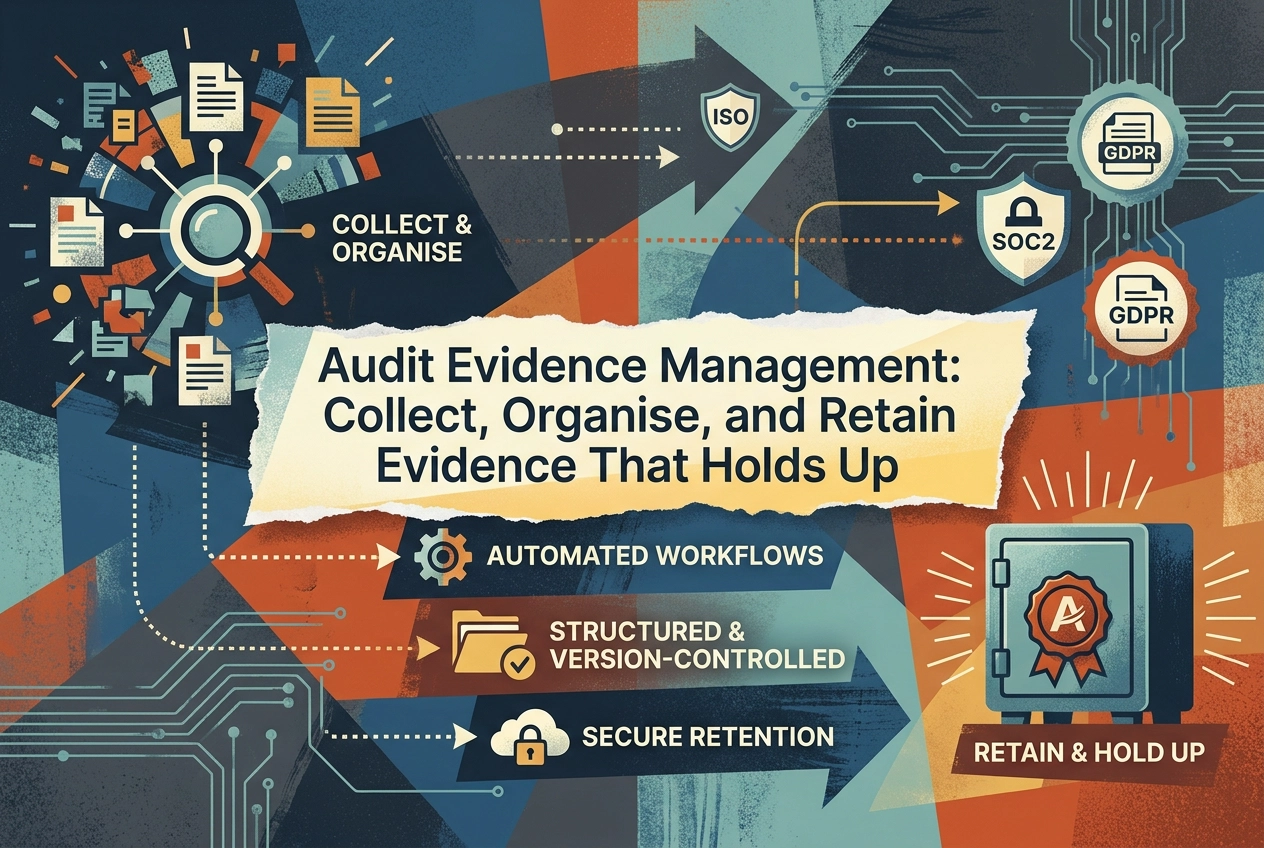
Most compliance teams treat audit evidence documentation as a sprint: gather the files, satisfy the auditor, then move on. The problem is that auditors return, frameworks multiply, and the evidence library you scrambled to assemble last quarter is already degrading. Retention schedules expire, document versions go untracked, and the next audit cycle arrives before anyone has addressed the gaps.
Managing audit evidence well is an operational discipline, not a one-time task. Done properly, it means maintaining a structured, version-controlled library that satisfies SOC 2, ISO 27001, GDPR, and any other frameworks your organisation is accountable to, simultaneously and continuously. For SaaS providers in particular, that library has become a commercial asset. Without demonstrable retention controls, enterprise procurement stalls before it starts.
This guide moves beyond defining what audit evidence is and focuses on how to architect a system that holds up under scrutiny. You will learn how to classify and catalogue evidence assets, build a version-controlled library with a clear audit trail, map evidence across frameworks, set defensible retention schedules, automate collection, and manage the full evidence lifecycle including disposal and legal hold.
Why Audit Evidence Management Is Not a One-Time Task
Most compliance teams treat audit evidence as a sprint: a concentrated burst of collection activity in the weeks before an audit window, followed by months of neglect. That pattern leaves systematic gaps. Auditors examining a full review period do not only see what you collected last month; they see everything, including what is missing.
The audit-ready state is perishable. Access logs reach their expiry without renewal. Policies get revised informally, with no prior version retained. Personnel changes leave ownership records pointing to people who no longer hold the relevant role. Each of these gaps is unremarkable in isolation; together, they are the most common reasons internal audit documentation fails under scrutiny between cycles.
The commercial stakes have risen alongside the compliance ones. Enterprise procurement teams now routinely assess a vendor's evidence controls before contracts are signed. Without demonstrable retention policies, version histories, and access governance, procurement stalls. Evidence management is no longer purely a certification concern; it is a revenue risk.
The 2025-2026 industry shift toward continuous compliance has sharpened this problem. Organisations are moving away from treating audits as discrete events, yet many teams remain operationally stuck: siloed systems that do not share data, manual collection workflows that break under volume, and growing framework obligations that multiply the evidence burden year on year.
The answer is not to run faster sprints. It is to architect a structured, version-controlled evidence library that stays current between cycles, maps artefacts across multiple frameworks simultaneously, and holds up under repeated auditor scrutiny. DataDoc's approach of taking compliance teams from upload to audit-ready in three steps reflects exactly that shift: treating evidence as a managed, living asset rather than a pre-audit deliverable.
The seven steps that follow show you how to build that library.
What Auditors Actually Examine: Audit Documentation Requirements by Framework
Before building a collection and retention system, it helps to understand precisely what each framework demands, because auditor expectations vary significantly across them.
SOC 2 assessors evaluate evidence against the five Trust Services Criteria: security, availability, processing integrity, confidentiality, and privacy. Critically, they examine evidence across the entire review period, not just a point in time. For a SOC 2 Type II engagement, auditors verify how data was stored, accessed, retained, and deleted throughout that window, meaning a single missing log entry mid-period is a finding, not a technicality.
ISO 27001 auditors go a step further by assessing implementation, not just policy existence. Organisations must define storage methods, disposal procedures, and explicit retention periods. An auditor presenting a clause from Annex A 8.3 expects to see the policy, evidence that it was followed, and a traceable record linking the two. Undated, unversioned policies fail this test even when the underlying practice is sound.
GDPR evidence obligations are broader than many teams anticipate. Under Articles 5(2) and 24, organisations must demonstrate accountability across lawful basis records, data subject request logs, data protection impact assessments, and breach notification timelines. Each category carries its own retention logic; GDPR does not prescribe a single uniform retention period, so evidence of the justification for each retention decision is itself an auditable artefact.
NIST 800-53 Rev. 5 is explicit about log integrity. Control AU-11 mandates that audit records are retained for a defined minimum period, and SI-7 requires that the evidence itself carries a verifiable chain of custody. If log files can be altered after the fact without detection, they fail the integrity requirement regardless of content.
CCPA adds a consumer-rights evidence layer: opt-out records, data inventory logs, and consumer request fulfilment timelines must all be demonstrable. These artefacts frequently overlap with GDPR documentation, making them efficient targets for shared collection.
The cross-framework implication is significant. A single access control policy can simultaneously satisfy SOC 2 CC6.1, ISO 27001 Annex A 8.3, and GDPR Article 32, but only if it is correctly tagged, versioned, and linked to each control at the point of collection. Without that structure, the same document must be relocated, reformatted, or re-evidenced for each separate audit, multiplying effort without multiplying compliance value.
Step 1: Classify and Catalogue Your Evidence Assets Before You Collect Anything
Knowing what each framework demands is only useful if your evidence is organised to deliver it. Before a single artefact is collected, build the catalogue that governs everything downstream.
Start with a control inventory. List every active control across your frameworks, then assign a specific artefact type to each: policy document, log export, screenshot, configuration record, or interview note. Vague mappings like "system evidence" create ambiguity at audit time. Each control should point to exactly one artefact type as its primary source.
Classify every item by sensitivity before storage. Assign one of four tiers at the point of collection: public, internal, confidential, or restricted. This classification is not administrative housekeeping; it determines which storage tier the artefact sits in, who can access it, and how long it must be retained. Applying classification retrospectively, after evidence is already stored and shared, is far harder and introduces gaps that auditors will find.
Assign a named owner to every catalogue entry. Unowned evidence is one of the most consistent findings in internal audit documentation reviews. Without a named individual accountable for keeping an artefact current, policies go unreviewed, log exports go stale, and no one notices until the audit request arrives. One owner per item; no shared or team-level assignments.
Define collection frequency explicitly. Each artefact type falls into one of three modes: point-in-time (annual policy approval), periodic (quarterly access reviews), or continuous (real-time log streaming). Mismatched frequency is a leading cause of stale evidence; a quarterly access review collected annually fails the control it is meant to demonstrate.
Record the source system for every artefact. When a cloud provider is replaced or an identity platform is migrated, a catalogue that lists source systems will surface which evidence pipelines need updating. Without it, the gap is invisible until an auditor requests evidence from a decommissioned system.
Step 2: Build a Version-Controlled Evidence Library With an Immutable Audit Trail
With your evidence catalogue in place, the next task is ensuring every artefact in that catalogue is stored in a way that holds up when an auditor asks: "Which version of this policy was in effect on 14 March?"
Version control is not optional for audit trail documentation. Auditors do not simply want to see the current state of a control record; they need to reconstruct the control environment at any point during the review period. A policy revised mid-cycle without a retrievable prior version creates an evidentiary gap that no amount of explanation will close.
Attach a minimum metadata set to every artefact at ingestion. Each item in the library should carry: a unique document ID, version number, effective date, expiry or review date, named owner, last-modified-by, and the specific framework controls it satisfies. This metadata is what makes the library queryable under audit pressure, rather than a folder someone has to manually search through.
Use an immutable, append-only log for change history. When a policy is revised, the prior version must remain retrievable in its original form alongside a clear record of who made the change, when, and why. Overwriting is not revision; it is evidence destruction from an auditor's perspective.
Retire shared drives and email attachments as version control mechanisms. Naming conventions such as "Policy_FINAL_v3_revised2.docx" degrade quickly. Concurrent edits create conflicting forks. Neither method produces an access log by default, which directly undermines the integrity of your audit trail documentation. These are not minor inconveniences; they are audit findings waiting to happen.
Establish a formal review-and-approval workflow for policy-type evidence. A document approved by the CISO, published as v2.1, and linked to a specific control carries measurably more weight than an undated file in a shared folder. The workflow itself becomes part of the evidence.
Test version integrity quarterly. Pull the library's evidence state as of a prior date and verify it matches the snapshot held at that time. This is the internal audit documentation equivalent of a backup restore test: straightforward in principle, rarely done in practice, and immediately revealing when something has silently drifted.
Step 3: Map Evidence Across Frameworks to Eliminate Redundant Collection
With your version-controlled library in place, the next challenge is ensuring that library does not silently expand through duplication.
Organisations running two or more frameworks routinely collect the same evidence multiple times in different formats, once per framework team, once per audit cycle, often with inconsistent naming. The artefact is identical; the overhead is multiplied. The fix is structural.
Build a cross-framework evidence matrix. Create a table where rows are evidence artefacts and columns are framework control identifiers. A single access control policy entry, for example, should carry checkmarks across SOC 2 CC6.1, ISO 27001 A.8.3, and NIST 800-53 AC-2, signalling that one collection event satisfies all three. The matrix makes overlap visible and turns a three-collection workflow into one.
Tag at ingestion, not at audit time. Every artefact must be tagged with all control identifiers it satisfies at the moment it enters the library. Without systematic tagging, the matrix degrades into a manual reconciliation exercise under audit pressure rather than a live, queryable index.
Prioritise shared artefacts for automation. Any artefact that maps to multiple framework columns delivers compounding returns when automated. Eliminating manual effort on a single high-overlap artefact reduces burden across every framework it serves simultaneously. Focus automation investment there first.
Document framework conflicts explicitly. Some artefacts face competing requirements. GDPR's data minimisation principle and SOC 2's availability criteria create genuine tension around log retention scope: GDPR pushes for less retained data; SOC 2 availability evidence may require more. Do not silently compromise one framework to satisfy the other. Record the conflict, the decision made, and the rationale, so auditors from either framework encounter a transparent, defensible position rather than an unexplained gap.
Step 4: Set Retention Schedules That Satisfy Each Framework's Requirements
Once your cross-framework matrix is built, the next question is how long each artefact must be kept. Applying a single blanket retention period is a common mistake that creates a compliance conflict in both directions: over-retaining personal data breaches GDPR Article 5(1)(e), which requires storage to be limited to what is strictly necessary, while under-retaining security logs breaches NIST 800-53 AU-11's minimum retention mandate.
Define retention per artefact type and per framework using these practical baselines:
Security and access logs: 1 year minimum for SOC 2 and ISO 27001; for NIST 800-53, many organisations implement 1-3 years depending on system criticality
Policy documents and superseded versions: 3 years, to cover rolling audit periods across consecutive cycles
Incident reports and breach records: 5 years or longer in regulated industries, to satisfy GDPR accountability obligations and sector-specific rules
Data subject request logs (GDPR and CCPA): minimum 2 years to evidence fulfilment compliance
Where frameworks assign different periods to the same artefact, record the conflict explicitly in your matrix and apply the longer period unless legal counsel advises otherwise.
Automate expiry alerting rather than relying on manual calendar reminders. Configure alerts at 60 days and 30 days before each artefact's retention end date. The responsible owner should either confirm scheduled disposal or initiate a legal hold review. Silent expiry, where data is deleted with no deliberate decision, is itself a compliance failure.
Treat the retention schedule as a versioned, auditable document in its own right. When a new framework is added, a regulation is revised, or internal policy changes, update the schedule formally, preserve the prior version with its effective dates, and log who approved the change. Auditors may need to verify which schedule was in force at a historical point in time.
For healthcare and financial services organisations, layer HIPAA, FCA, and PCI DSS obligations on top of framework baselines before finalising any period, and resolve upward.
Step 5: Automate Evidence Collection to Eliminate the Manual Bottleneck
Retention schedules define how long evidence must live; automation determines whether it arrives at all. With retention rules in place, the next failure point is the collection process itself.
Manual evidence collection remains the single largest source of audit-readiness failures heading into 2026. Siloed teams pull exports in inconsistent formats, data volumes grow faster than spreadsheet-based workflows can absorb, and point-in-time collection always misses something. The result is a last-minute scramble that produces incomplete evidence and auditor queries that could have been prevented.
API-driven log aggregation is the practical fix. Connect source systems directly to your evidence library: identity providers, cloud infrastructure, HR platforms, and endpoint management tools should push data continuously via API rather than waiting for a human to trigger an export. Logs that flow automatically are logs that exist when the auditor asks for them.
Automate policy-to-evidence linking at the point of approval. When a policy is published and signed off, the workflow should immediately attach it to every control it satisfies in the evidence library. Most teams currently perform this tagging manually in the days before an audit, under pressure, and with gaps. Moving it to an automated post-approval step removes the bottleneck entirely.
Separate your automation pipelines by collection type:
Continuous collection covers security logs, access logs, and configuration monitoring. These should never require a human trigger; any gap in the feed is itself an anomaly worth investigating.
Scheduled collection covers quarterly access reviews, annual risk assessments, and similar periodic artefacts. Automate the initiation and routing of these reviews so they complete on time rather than slipping.
DataDoc connects directly to source systems, integrates with over 100 compliance frameworks, and generates audit-ready reports in minutes, maintaining the evidence library between cycles without manual intervention.
Validate automation weekly, not at audit time. Run exception reports every week: confirm each expected evidence item has been collected, flag missing items, and route gaps to the responsible owner immediately. Catching a broken API connection in week two of a quarter costs minutes to fix; discovering it during fieldwork costs days.
Step 6: Structure Evidence for Auditor Accessibility Without Compromising Security
Automated collection solves the supply problem; accessibility solves the delivery problem. Once evidence is in the library, auditors need to reach any specific artefact quickly and independently.
Auditor accessibility is a distinct design requirement from internal usability. Your team navigates the library by muscle memory. Auditors arrive with a control reference list and no prior context. The practical target: from a control request to the supporting artefact in under two minutes, without contacting the compliance team.
Build a dedicated auditor workspace. Create a filtered, read-only view of the evidence library, scoped strictly to the audit period, organised by control domain, and pre-populated with direct links between each control and its evidence. This is separate from your working library, so auditors cannot inadvertently access evidence outside their scope or permissions.
Scope and log all access. Grant auditors time-limited, role-scoped credentials that expire automatically at the end of the audit window. Log every access event in the same audit trail used for internal activity. Access must be revocable instantly without touching the main evidence library. This satisfies the access management requirements in SOC 2 CC6 and ISO 27001 Annex A without creating a separate governance burden.
Package evidence around the auditor's workflow. Each evidence package should present five elements in sequence:
Control reference
Assertion the evidence supports
Supporting artefact
Artefact metadata (owner, version, effective date)
Collection method
That sequence lets auditors verify completeness and provenance without back-and-forth queries.
Prepare a standard evidence index before the audit opens. A single-page document mapping each requested control to its evidence location, with direct links, removes the most common source of auditor queries. Teams that provide this at the outset consistently reduce query volume and close audit cycles faster than those who rely on auditors to navigate unaided.
Step 7: Manage the Post-Audit Evidence Lifecycle Including Disposal and Legal Hold
Audit closure is not the end of your evidence obligations; for many frameworks, it is when the legally significant retention period begins.
Once the audit is closed, retain the complete evidence package, including auditor correspondence, queries raised, and responses provided. For SOC 2 Type II, this means holding evidence through the next audit cycle and keeping it accessible for customer due-diligence requests, which can arrive at any point. Match retention periods to each applicable framework rather than applying a single blanket rule.
Establish a legal hold process before you need it. If an incident, regulatory investigation, or litigation touches evidence from a prior audit period, that evidence must be flagged immediately and removed from the normal retention schedule. It must be preserved intact, regardless of its scheduled disposal date, until the hold is formally lifted by legal or compliance leadership. Document the hold trigger, scope, and release in the audit trail.
Dispose of evidence securely and provably. When an artefact reaches its retention end date and carries no legal hold, delete it completely. Deletion must cover all copies, including backups and archive tiers, and must be logged in the audit trail. Undocumented disposal is itself a compliance finding under frameworks such as ISO 27001 and GDPR, where demonstrating control over the full data lifecycle is a requirement, not an option.
Treat the post-audit period as a structured improvement window. Before the next cycle begins, review which evidence items generated auditor queries, which arrived late, and which required remediation. Feed those findings directly back into your collection catalogue and automation configuration. A query that recurs across two consecutive audits signals a systematic gap in your evidence architecture, not a one-off oversight.
These four disciplines, retention, legal hold, secure disposal, and retrospective improvement, close the lifecycle loop that most audit documentation guidance leaves open.
Keeping the Evidence Library Current Between Audit Cycles
Post-audit improvements feed back into the catalogue, but the harder problem is keeping the library accurate during the long stretch between certification cycles. This is where evidence libraries quietly decay.
Control owners change roles and their evidence items go unclaimed. Systems are replaced without updating the collection pipeline. Policies are revised informally without a version record. By the time the next audit begins, the catalogue reflects last year's control environment, and rebuilding it under time pressure is costly and error-prone.
Run quarterly evidence health checks. Assign each control owner a structured review: confirm every evidence item they own is current, correctly versioned, and mapped to the right controls. This takes roughly 20 to 30 minutes per owner per quarter. Teams that run these checks consistently avoid the multi-month remediation sprints that are otherwise the norm in the weeks before an audit window opens.
Treat system migrations as an evidence pipeline trigger. When a cloud provider is replaced or an identity platform is migrated, the evidence collection rules for that source must be updated before the old system is decommissioned. Updating pipelines after decommissioning means there is a gap in collection history that cannot be retroactively filled, creating an immediate finding.
Monitor framework updates with the same discipline. When ISO 27001 publishes an amendment or a regulator revises its audit guidance, run a gap review of the evidence catalogue against the new requirements and update collection rules accordingly. Framework changes are a known, foreseeable trigger; treating them reactively adds unnecessary remediation work.
Conduct mid-cycle internal audit documentation reviews. Pre-audit reviews catch problems late. A mid-cycle review, scheduled roughly halfway through the certification period, identifies control ownership gaps, stale artefacts, and missing evidence while there is still time to resolve them without pressure. This single practice, more than any other, keeps the library representative of the organisation's actual control environment rather than a snapshot of where it stood at last certification.
Building an Evidence Library That Works Beyond the Audit Window
Keeping the evidence library current is necessary, but it is not sufficient. The teams that perform best under auditor scrutiny are not the ones that collect the most evidence; they are the ones that maintain it systematically across every cycle.
The seven steps in this guide form a single, sequential system: classify and catalogue every control and its required artefact, build version-controlled storage with an immutable change history, map evidence across frameworks to eliminate redundant collection, set per-artefact retention schedules that satisfy each applicable framework, automate collection pipelines so evidence flows continuously rather than in pre-audit sprints, structure the library for auditor accessibility, and manage the post-audit lifecycle including secure disposal and legal hold.
The economics matter here. The primary reason teams revert to manual, sprint-based approaches is the maintenance burden of running this system by hand across multiple frameworks. Automation removes that burden. Continuous collection replaces reactive scrambling, cross-framework tagging replaces duplicated effort, and automated retention alerts replace the silent expiry risk that undermines audit trail documentation integrity.
DataDoc connects directly to source systems, automates evidence collection across 100-plus frameworks, and generates audit-ready reports in minutes. A 14-day free trial, with no credit card required, gives compliance teams a concrete starting point without committing to a full implementation before they have seen the results.
The immediate next step is straightforward: build the evidence catalogue. List every active control, the artefact type that satisfies it, and the named owner responsible for keeping it current. That catalogue is the master record from which every collection rule, version policy, retention schedule, and auditor access decision flows. Everything else in this guide depends on getting that foundation right.
Conclusion
Audit evidence management is not a pre-audit scramble; it is a continuous discipline built on four foundations: a classified evidence catalogue, a version-controlled library with an immutable audit trail, cross-framework mapping that eliminates redundant collection, and automated pipelines that keep evidence current year-round.
Teams that get this right spend less time gathering evidence and more time strengthening controls. They enter every audit cycle prepared, not reactive.
The starting point is always the catalogue. Define every control, every artefact type, and every named owner before you build anything else. That single document drives every retention schedule, collection rule, and access decision downstream.
Ready to replace the annual evidence sprint with a system that runs continuously? Start your 14-day free trial with DataDoc and see how fast audit-ready evidence can be when the infrastructure is built correctly.
Frequently asked questions
- Why is audit evidence management treated as a one-time task, and what are the consequences?
- Many compliance teams treat audit evidence as a pre-audit sprint rather than an ongoing discipline, focusing on collection in the weeks before an audit and then neglecting it for months afterward. This approach creates systematic gaps because auditors examine the entire review period, not just recently collected evidence. Consequences include expired access logs, untracked policy revisions, outdated personnel records, and missing documentation. These gaps collectively lead to audit findings and, increasingly, create commercial risks—enterprise procurement teams now assess vendors' evidence controls before signing contracts. Without demonstrable retention policies and version histories, vendor relationships and revenue can be jeopardized.
- What is the difference between how SOC 2, ISO 27001, and GDPR auditors evaluate evidence?
- Each framework has distinct evaluation approaches: SOC 2 assessors examine evidence across the entire review period (not just point-in-time) against the five Trust Services Criteria and verify data handling throughout the window. ISO 27001 auditors go further by assessing actual implementation, not just policy existence, and require traceable records linking policies to practices—undated, unversioned policies fail even when underlying practices are sound. GDPR auditors focus on accountability across multiple categories (lawful basis records, data subject request logs, DPIAs, breach notifications) with different retention logics for each. The key implication is that a single policy can satisfy multiple frameworks simultaneously, but only if it is correctly tagged, versioned, and linked to each control at collection point.
- How should organisations handle conflicting retention requirements across different frameworks?
- When frameworks assign different retention periods to the same artefact, organisations should record the conflict explicitly in their cross-framework evidence matrix and apply the longer retention period unless legal counsel advises otherwise. For example, GDPR's data minimization principle pushes for limited data retention, while SOC 2's availability evidence requirements may necessitate longer retention periods. Rather than silently compromising one framework to satisfy another, document the conflict, the decision made, and the rationale. This transparent, defensible position ensures auditors from either framework understand the organisation's approach. Additionally, organisations in regulated industries (healthcare, financial services) must layer HIPAA, FCA, and PCI DSS obligations on top of framework baselines before finalizing any retention period.
- What is the most common source of audit-readiness failures, and how can it be prevented?
- Manual evidence collection remains the single largest source of audit-readiness failures heading into 2026. Siloed teams pull exports in inconsistent formats, data volumes exceed spreadsheet workflow capacity, and point-in-time collection always misses something, resulting in last-minute scrambles and incomplete evidence. The practical solution is API-driven log aggregation: connect source systems directly to the evidence library so identity providers, cloud infrastructure, HR platforms, and endpoint management tools push data continuously via API rather than requiring human triggers. Additionally, policy-to-evidence linking should be automated at the point of approval rather than manually during pre-audit periods. Teams should validate automation weekly through exception reports rather than waiting until audit time to discover broken collection pipelines.
- What should organisations do immediately to establish a foundation for proper evidence management?
- The immediate starting point is building an evidence catalogue that serves as the master record for all downstream decisions. This catalogue should list every active control across applicable frameworks, assign a specific artefact type to each control (policy document, log export, screenshot, etc.), classify every item by sensitivity tier (public, internal, confidential, or restricted), assign a named owner to every entry, define collection frequency explicitly (point-in-time, periodic, or continuous), and record the source system for every artefact. This foundational catalogue should be completed before any collection infrastructure is built, as it drives every retention schedule, collection rule, version policy, and auditor access decision. Organisations that invest time in this upfront work avoid multi-month remediation sprints and prevent the silent decay that typically occurs between audit cycles.
Ready to automate your compliance?
Experience the power of AI-driven compliance automation with DataDoc. Transform weeks of work into minutes.